
Place de la Concorde, 1875
🖌 Edgar Degas
1834–1917 · PARIS
Degas trained like an academic, exhibited with the Impressionists, and insisted he was neither. What he truly was, from first sketch to last pastel, was a designer. Every ballet class, café corner, and orchestra pit is a rectangle solved like a chess problem: where the emptiness goes, where a figure gets sliced by the edge, how a floor tips up and becomes shape. “No art was ever less spontaneous than mine,” he said. This room takes him at his word.
Design the rectangle first — the subject comes second.
From the gallery · Wall 1
🧩 The Composition Room
Six design moves Degas made again and again. Hunt for them in every painting below.
⭕ The Off-Center Star
Degas pushes his subject toward the edge and leaves the middle strangely open. The eye has to travel, and the picture starts to feel like a glimpse instead of a pose. Cover the middle of a Degas — the design still works.
✂️ Cut by the Frame
Figures enter half-visible: a dancer missing a head, a double bass missing its body. The frame behaves like a window, not a stage — the world clearly continues past the edges. He learned that honesty from photographs and Japanese prints.
◢ Tip the Floor
Degas loved balconies and stage wings because looking down turns the floor into one huge tilted shape. The raked stage becomes a diagonal that carries every dancer on it. When the floor is designed, the figures can relax.
⬜ Let Emptiness Work
In the rehearsal rooms, half the canvas is bare floorboards. That emptiness is not leftover space — it is pressure. It gives the cluster of dancers something to lean against, the way silence makes music louder.
🪞 Frames Inside the Frame
Doorways, mirrors, music stands, the scroll of a double bass — Degas plants interior frames that aim your eye at what matters. Find the second frame in any Degas and you have found his plan.
🗾 The Japanese Print Lesson
Degas collected ukiyo-e prints and stole their courage: high viewpoints, flat bold shapes, subjects shoved to one side. When your composition feels timid, ask what Hiroshige would have cut.
🎯 TRY THIS — The Viewfinder Game
Cut two L-shapes from cardboard and clip them into an adjustable rectangle. Hunt one ordinary room the way Degas hunted the opera house: find five compositions where the main thing is off-center, touching an edge, or half cut off. Thumbnail each one small and fast — shapes only, no detail. Then pick your best rectangle and ask: what is the emptiness doing in it?
From the gallery · Wall 2
🔪 The Torn Gift
One painting, two friends, one knife — a true story about how much design can survive.

Monsieur and Madame Édouard Manet, c. 1868–69 · Kitakyushu Municipal Museum of Art
Around 1868 Degas painted his two friends at home: Édouard Manet sprawled on the sofa, listening, while his wife Suzanne plays the piano. He gave the canvas to the couple as a gift. On a later visit he discovered that Manet — unhappy with how Suzanne’s face had turned out — had taken a blade to the picture and cut her profile clean off.
Degas lifted the painting off the wall, carried it home, and, the story goes, sent back the little still life Manet had once given him with a note: “Monsieur, I am returning your Plums.”
He tacked a strip of blank canvas along the cut, meaning to repaint Suzanne one day. He never did — and the blank strip is still there. Look closely at the picture: even torn, the rectangle still works. Manet’s dark slouch leans into the void exactly the way the dancers lean into empty stage. Degas kept the ruined gift, perhaps, because the design — even broken — was still his.
Find the design: cover the blank strip with your hand, then uncover it. Does the emptiness hurt the picture — or is it doing a job?
From the gallery · Wall 3
🖼 The Collection
Four rectangles worth stealing. Squint first — read the shapes before the story.

The Ballet Class · 1874
Find the design: the old master Perrot is the still point; the dancers wheel around him and the floorboards aim the whole room at his stick.

The Orchestra at the Opera · c. 1870
Find the design: three stacked bands — dark scrolls, lit faces, glowing stage — and the famous joke: the dancers lose their heads to the frame.

In a Café (L’Absinthe) · 1876
Find the design: the zigzag of empty tabletops shoves the couple into the top corner. All that bare marble is the loneliness.

Miss La La at the Cirque Fernando · 1879
Find the design: one diagonal, seen from below. She hangs by her teeth in the corner — and the architecture does the rest.
From the gallery · Wall 4
🎥 The Projection Room
Hannah’s picks. Watch for the design decisions, not just the dancers.

Edgar Degas: A Strange New Beauty
The Museum of Modern Art
👁 Look for: how he repeats one design across monotypes, nudging the rectangle until it works.

How Degas Distinguished Himself From the Other Impressionists
Perspective
👁 Look for: the planner among the plein-air painters — everything built in the studio, from memory and drawing.
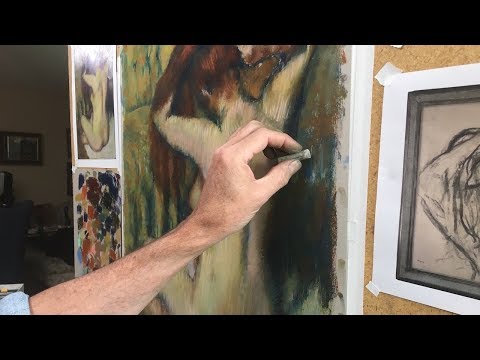
Decoding Degas: Pastel Master Copy
ArtistsNetwork
👁 Look for: strokes that follow the form and layers left deliberately broken.

The Degas Pastel Technique
Blick Art Materials
👁 Look for: the monotype hiding underneath and the fixative between pastel layers.
From the gallery · Wall 5
🏋 Keep Training
👁 Train Your Eye with Degas
- ⚖️ Value Detective — squint at a Degas and the whole design becomes a value map. Prove it to yourself.
- 🔍 Edge Detective — where the pastel edge disappears, the shape begins.
- 🎨 The full Train Your Eye gym — all the games in one room.
🎨 Where we teach it: Art from Art
Composition is learned by stealing from the masters — politely. In Art from Art we copy the design bones of paintings like these and make them our own.
Open the course →Pick one Degas a week and copy only its shapes — five values, no faces, ten minutes. Your compositions will change within a month.
Know a video or a painting that belongs in this room? Tell Hannah.